Delve into the vibrant heritage of Wales, the profound symbolism of the golden dragon emblem, and an inspiring vision for the future of Wales, featuring five kingdoms, fifteen castles, and a contemporary charter shaped by the Laws of Hywel Dda.

Embracing a Unified Vision: The Golden Dragon of Wales
Let me introduce myself; I am Goldie The Grey.
The significance of gold warrants explanation, while the meaning of grey is more evident.
What does the golden dragon truly represent?
This emblem encapsulates a rich story. So, pour yourself your drink of choice—be it coffee, tea, or something stronger—and settle in as I take you on a journey through the tales I share.
Initiating a Journey of Discovery
You might envision my adventure beginning with a sword, a prophecy, or a mysterious figure appearing on a particularly stormy night.
In truth, it commences with the task of digitising my mother’s paperwork for future generations.
This task may seem daunting.
Family documents often transcend mere paperwork. A name transforms into an inquiry. A branch of the family tree evolves into a journey. Before long, you find yourself contemplating your family tree and questioning how much of your identity you truly understood before embarking on this exploration.
This journey expanded beyond just preserving my mother’s documents.
Discovering the Ancestors Who Connect Us
In tracing my lineage, I find myself thirty-five generations removed from Rhodri Mawr.
This connection shapes my understanding of ancestry. Following these generations is crucial, as a family tree signifies more than a simple line drawn between a monarch and a contemporary individual.
There are individuals who link us.
Individuals who managed households, nurtured children, endured losses, and made vital decisions.
These are lives deserving of more than a hasty overview in pursuit of a distinguished name.
I long to learn about them, too.
I strive to create space for the family stories that do not neatly fit into a chart.
Because the House of Rhodri, as I have come to appreciate it, is an extraordinary lineage.
A Family Rich in Mystical Diversity
Witches, mages, shamans, seers, healers, empaths, and mystics.
These terms only begin to capture the mystical experiences within my family.
Not everyone might choose the same language. Each generation may have interpreted these concepts in their own unique ways.
I do not suggest that every ancestor left behind formal documentation to denote their distinct roles.
My mother certainly had more than enough paperwork already.
These elements form part of the lexicon through which I understand our family: love, intuition, mystical practices, inspiration, care, and experiences that often require more time to express than to feel.
I can share those narratives without expecting every listener to interpret them as I do.
They hold intrinsic value simply by existing.
Developing My Personal Understanding
I describe certain experiences as shamanic and others as mage-like. Inferred
These terms resonate closely with my intent.
The experiences associated with those labels warrant their own narrative. I wish to avoid cloaking them in borrowed mystique or suggesting that I trivialise them simply by applying a mystical label.
This space allows for faith.
It also encourages inquiry.
As I narrate this story, I aim to differentiate between my memories, what my family has shared, what I can document, and what I derive from my own mystical journey.
The golden dragon can embody profound significance without needing to serve as absolute proof of everything.
Claiming My Kingdom: A Vision for Wales
Before anyone gets too carried away:
I am not laying claim to a throne.
I am claiming a kingdom.
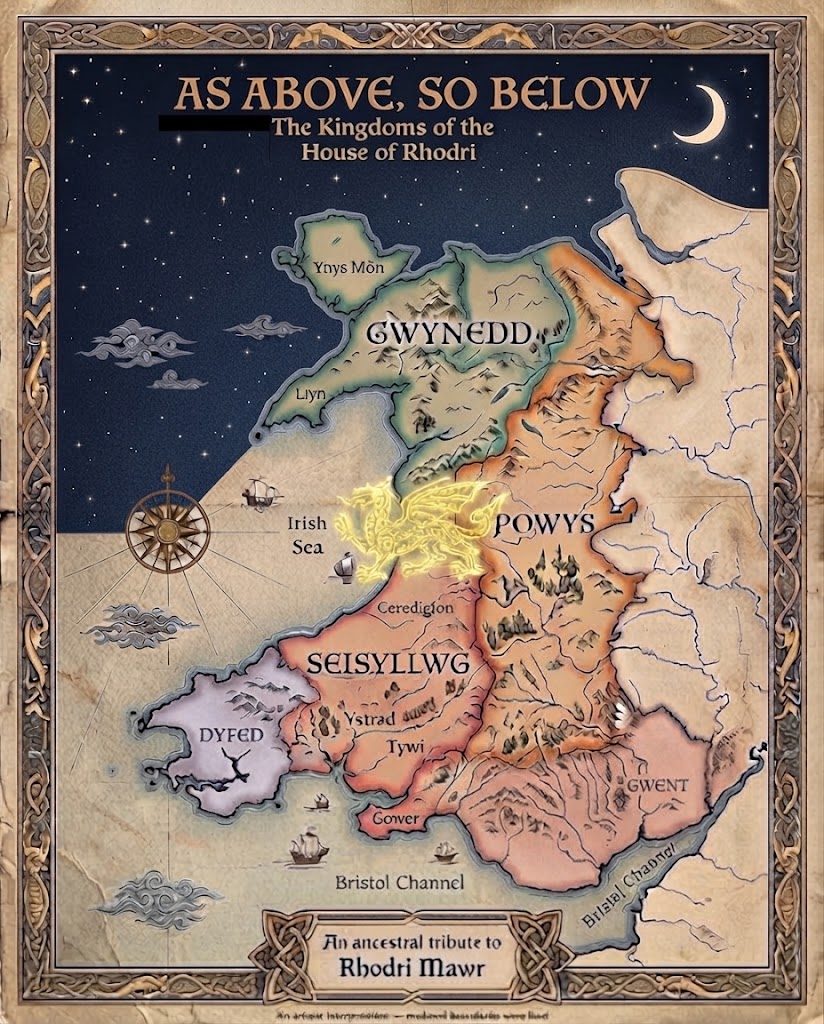
The celestial kingdom of Wales represents the mystical landscape of this narrative: ancestry, imagination, belonging, and a vision of what could still be achieved.
As Above, So Below.
On the map, that vision begins to take form.
Gwynedd.
Powys.
Seisyllwg.
Then Dyfed and Gwent.
Five Names, Five Colours: Envisioning a Unified Wales
The map arose from an interest in Rhodri’s realm, yet the conversation did not remain confined to the past.
The family narrative extends well beyond the initial three coloured areas. As it developed, so did the vision.
This distinction is vital:
We are not merely redrawing history and pretending it always appeared this way.
We are imagining a future.
Our five-kingdom map is a proposal articulated through narrative and art. Its boundaries represent the contours of an idea, rather than asserting that every segment belonged to a single ruler at a specific historical moment.
The House of Rhodri is the name under which I am constructing this vision.
Identifying the Castles That Shape Our Vision
Then came the castles.
To discuss five kingdoms, we must identify the places within our vision.
Fifteen castles became our initial landmarks.
These are not the only castles in Wales, nor do they encompass the entirety of the story. They serve as fifteen points from which we can begin weaving its threads.
In our Gwynedd, we acknowledge Caernarfon, Conwy, and Harlech.
In our Powys, we recognise Powis, Montgomery, and Dolforwyn.
In our Seisyllwg, we highlight Cardigan, Dinefwr, and Carreg Cennen.
In our Dyfed, we name Pembroke, Carew, and Manorbier.
In our broader Gwent, we mention Caerphilly, Cardiff, and Chepstow.
There they stand.
Fifteen Castles Creating Five Kingdoms Within a Unified Vision
Within the vision of the House of Rhodri, each castle stands beneath the golden dragon.
This is their place in the narrative; not by claiming they were all built by our ancestors or that their histories began with us. Each castle has its own rich history, and this assertion does not alter its current ownership or stewardship.
We are envisioning how these sites might merge into a collective future.
Some may enter our family story through a memory, while others could connect through undiscovered links. Some might serve as spaces for reflection, contemplation, and envisioning the future we desire for Wales.
Identifying them makes the vision feel more attainable.
To say “five kingdoms” leaves others imagining nearly anything.
But to mention Caernarfon, Dinefwr, or Pembroke.
Suddenly, there are destinations to explore, questions to ask, and stories to uncover.
The map transforms into a journey waiting to unfold.
Which is all well and good.
Before anyone wonders where I plan to hide the keys to fifteen castles (that’s a secret!), let me remind you that this all began with the need to find a digital home for my mother’s paperwork.
We are tackling one responsibility at a time.
The Flag That Symbolises Our Vision
Next, we designed a flag to embody our vision.
For this proposed flag, we retained the white above and the green below, placing a golden dragon at the centre, where the red dragon typically resides. The red dragon embodies raw emotion, will, fire, and ash. In its place, we envision purpose, love, and courage.
The white signifies the heavens.
The green represents the earth.
The golden dragon embodies our aspirations for Wales’ prosperity within our vision of the House of Rhodri.
To me, these colours articulate the belief that God created both the heavens and the earth. They unite the mystical with the terrestrial in a singular image.
As Above, So Below.
And beneath that image, our guiding principles:
<em>Peace, Prosperity, Patience & Justice Under God.</em>
-
Peace – not a demand for uniformity, but a commitment to foster understanding without coercion.
-
Prosperity – not wealth concentrated in a few hands, but the flourishing of individuals, communities, culture, and land.
-
Patience – since a future worth building cannot be conjured into existence simply by declaration.
-
Justice – as none of the other promises carry weight if individuals cannot expect fair treatment.
“Under God” expresses my unwavering faith and the sense of responsibility that accompanies it. It is not necessary for everyone to share my beliefs.
No one should be compelled to adopt a religion, accept a mystical claim, or recognise the sacredness of the dragon to enjoy equal dignity.
I would raise this flag as an invitation to reflect upon a vision.
Not as a means to silence another’s voice.
What Values Will Define Our Kingdoms?
A map provides an excellent starting point.
It is insufficient for governance.
Eventually, someone will justifiably inquire about the practical implications.
What does this entail for the inhabitants of these lands?
This is a valid concern.
A golden dragon is striking, yet it cannot resolve grievances merely by shining more brightly.
The narrative necessitates a charter.
I do not endorse the current governmental framework as the future I envision for Wales. Yet, discontent, however intense, marks only the beginning of a conversation.
If I am to advocate for an alternative future, I must be prepared to articulate it.
This includes not only identifying who would be central to the map.
How power would be constrained.
How the voices of the people would be amplified.
How one could dissent from the House of Rhodri while remaining equally free, safe, and Welsh as anyone else.
A Contemporary Charter for Progress
As a foundation for this vision, we have chosen to draw inspiration from Cyfraith Hywel … the Laws of Hywel Dda.
This does not entail a literal revival of every medieval statute.
Rather, it is about a contemporary charter rooted in that heritage, thoughtfully examined and crafted for the people who would live under it today.
This is the proposal we have begun to articulate.
No longer the Laws of the Sea; we demand the Laws of the Land …
Equal dignity.
Freedom of conscience.
Freedom of speech.
Leadership accountable for its decisions.
Justice that seeks to mend harm when possible while safeguarding those who have suffered.
Stewardship of the land, water, minerals, language, traditions, and places entrusted to us.
A meaningful voice for individuals across all five kingdoms.
These are commitments we must uphold in practice, not mere phrases to adorn an attractive image.
The charter must accommodate people whose beliefs diverge from mine.
There must be space for the mystic and the sceptic, for the religious and the agnostic, for those who find significance in the dragon and those who appreciate the artistry.
No one should need to share my mystical insights to possess equal rights.
Justice Within the Castle Walls
In this envisioned future, the castles would serve a purpose beyond their geographical locations.
We foresee them as homes for courts: venues where justice reverberates within the communities they serve.
This would not be the existing judicial framework with a new flag draped above its entrance, but an alternative proposal whose authority derives from an agreed charter and laws openly established with the consent of the populace.
Our intention is for all courts to convene in castle settings, where conservation, safety, and accessibility can align with that purpose. If a site cannot accommodate a functional court, suitable facilities must be considered without compromising the integrity of the location we aim to honour.
A symbol holds no value to justice if individuals cannot enter.
Judgment would be entrusted to the community; members of society under the new laws we propose.
“The community” must never become synonymous with the loudest voices within it.
A person should not lose a case due to unpopularity, unfamiliarity, poverty, or difference.
Knowing someone’s reputation must not be confused with understanding the evidence.
The charter should include clear safeguards: impartial selection, the removal of anyone with conflicts of interest, independent legal counsel, and a fair opportunity for each party to be heard.
Anyone accused would be presumed innocent unless the evidence meets the legal standard. They would have the right to understand the allegations, receive legal support, contest the evidence, and seek an independent appeal.
Those who report harm deserve safety, dignity, and support throughout the process.
Decisions must be justified.
The laws themselves should be public, comprehensible, and subject to challenge and revision through agreed procedures.
And no individual—not a leader, not a relative, not the visionary behind this concept—shall have the authority to dictate a verdict.
Including myself.
Especially if I happen to be standing beneath an especially imposing dragon at the time.
Where harm can be rectified, the court should seek meaningful restoration. Where protection is needed, it must be provided. Forgiveness may be freely extended but must never be demanded from those who have been harmed.
This is the justice I envisage for these castle courts.
Not spectacle.
Not retribution.
Responsibility, equity, and a path forward.
These are proposals for a potential future, not courts we can manifest into lawful existence merely by declaring them. Until any changes are lawfully instituted, the vision will not replace existing courts or absolve anyone of their current legal responsibilities.
The Significance of a House
When I refer to a “House,” I intend for it to embody a sense of responsibility.
My ancestry may illuminate why I embarked on this journey. It does not render me more valuable than those alongside me.
It does not place me above the law.
Nor can it, in isolation, grant me authority over individuals who have not consented to it.
Any future political arrangement must secure the freely expressed consent of the people, achieved through peaceful and lawful transformation.
Otherwise, we would have sketched five kingdoms without addressing the most crucial question:
Whose home are we discussing?
Wales is already inhabited by individuals with their own lives, beliefs, aspirations, and disagreements.
A meaningful vision must encompass them.
The House, as I envision it, must be capable of listening as well as speaking.
And if its proposals cannot withstand critical examination, then those proposals require further development.
The Awakening of a Vision
When I assert that the Golden Dragon of Wales is awake, I am naming the awakening at the core of this narrative.
My growing awareness of family.
My quest for a language to articulate mystical experiences.
My desire to envision a Wales oriented around belonging, responsibility, and justice.
The dragon serves as the symbol I have chosen to encapsulate these ideals.
Its awakening does not prove that I possess all the answers.
It signals the commencement of exploring what I intend to do with these inquiries.
What does my ancestry demand of me?
What does my faith require in how I treat someone who does not share it?
What changes would I be willing to consider in my own vision after listening to another perspective?
These questions belong beneath the flag as much as any declaration.
The Current State of Our Narrative
This is our present situation.
A lineage being traced.
My mother’s research.
My own efforts to articulate experiences that hold significance for me.
Five kingdoms depicted on a map.
Fifteen castles identified within the vision.
A proposed flag of white, green, and gold.
And the inception of a charter: a framework for discussion, testing, questioning, and improvement.
There remains much that I do not know.
This is not a reason to fabricate the missing pieces.
It is a reason to continue searching.
They call me Goldie The Grey.
The gold requires clarification.
The grey is self-explanatory.
If you expected a demand for a throne, you may need to settle for a family narrative, a proposed charter, and a rather ambitious map.
All of which originated from the need to find a digital home for my mother’s research.
Peace, Prosperity, Patience & Justice Under God.
As Above, So Below.
The Golden Dragon of Wales is Awake – Book 1
A fictional series following Goldie the Grey, the golden dragon, and a vision for Wales. Read the episodes in sequence:
The post The Golden Dragon of Wales Has Awoken appeared first on Limits Of Strategy.
The Article The Awoken Golden Dragon of Wales found first on https://electroquench.com